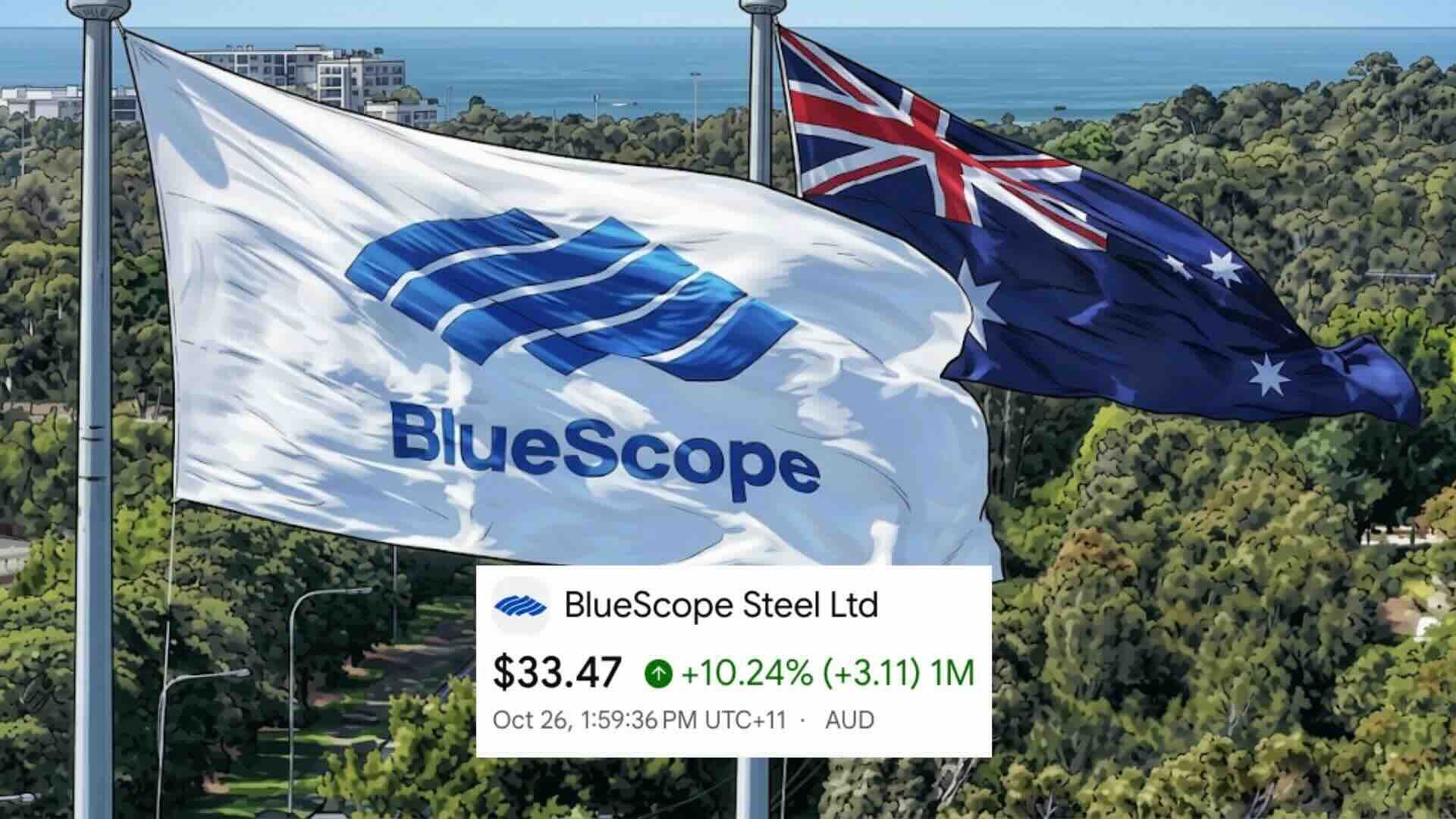
BlueScope Steel’s first-half earnings are now expected to reach approximately $1.1 billion, a substantial upgrade that highlights the earning power of its North American operations when steel markets improve. The key question for investors is whether this performance signals a more durable improvement in profitability or another peak in a cyclical industry.
Key numbers
- $1.1 billion: Expected underlying EBIT for the first half of FY2027, up from previous guidance of $860 million to $960 million.
- About $810 per tonne: Steel spread assumption underpinning stronger North Star earnings, compared with the previous $750 per tonne assumption.
- $1.27 billion: Underlying EBIT reported for FY2026.
- $802 million: Reported net profit after tax in FY2026, up 857% on the previous financial year.
- $14.2 billion: Approximate market capitalisation following the latest share-price movement.
The latest development
BlueScope’s upgraded guidance reflects stronger-than-expected performance across North America and Australia. North Star, its US steelmaking business, is the main contributor, benefiting from wider steel spreads and higher despatch volumes following a project to increase production capacity.
Buildings and Coated Products North America is also expected to improve, supported by stronger volumes and realised prices. Meanwhile, Australian Steel Products is forecast to deliver earnings approaching double those recorded in the second half of FY2026, helped by resilient domestic demand and better sales margins.
The breadth of the improvement matters. Rather than relying on one operation alone, BlueScope is seeing better conditions across several businesses. However, North Star remains the critical earnings driver, making the group sensitive to changes in US steel prices, production costs and demand.
What stands out to us
BlueScope's competitive advantage lies in its established manufacturing assets, customer relationships, distribution networks and branded products, including COLORBOND and ZINCALUME. These are difficult to replicate quickly and provide a stronger position than competing solely on commodity steel prices.
Its North Star operation is particularly important because its earnings can benefit significantly when US steel spreads widen. The recent capacity improvements also offer the potential to generate additional output without requiring an entirely new steelmaking facility.
However, we would not extrapolate the latest earnings upgrade indefinitely. Steel is a cyclical business, and favourable spreads can narrow as supply increases or demand weakens. BlueScope's FY2026 results illustrate this variability: North American operations generated $1.03 billion in underlying EBIT, while Australian Steel Products contributed $188 million.
At approximately $14.2 billion in market capitalisation, the shares also require careful valuation. Compared with FY2026 underlying net profit of $851.2 million, the equity trades at roughly 16.7 times earnings. That multiple is not obviously cheap for a cyclical steelmaker, particularly if current margins prove temporary. Conversely, sustained higher earnings could make the valuation more attractive on a forward basis.
What the company is doing now
BlueScope has been investing to strengthen production capacity and improve operational efficiency, including the North Star debottlenecking project. It is also advancing major Australian manufacturing projects and focusing on higher-value coated and painted steel products.
These initiatives aim to improve volumes, product mix and returns from existing assets. The challenge is ensuring that the additional production translates into sustainable free cash flow after capital expenditure, maintenance and other operating costs.
Investor Insight: Can BlueScope sustain its earnings momentum?
We view BlueScope's guidance upgrade as a meaningful positive because it demonstrates the earnings potential of its established North American assets and improving Australian operations. Its manufacturing scale and branded products provide genuine competitive advantages, but its profitability remains exposed to steel-market cycles. The investment case therefore depends less on whether earnings can reach $1.1 billion in the first half and more on how much of that performance can be sustained. We would become more constructive if subsequent results confirm strong cash generation through changing market conditions.


 Mark Elzayed•





