A $6 million capital raising could accelerate Aurora Labs' transition from developing advanced propulsion technology to manufacturing turbojet engines at commercial scale. But with annual revenue below $600,000 and mounting losses, the bigger question is whether expanded production capacity can translate into sustainable earnings.
For Aurora Labs Limited (ASX: A3D), the funding represents an important commercialisation milestone, although existing shareholders face meaningful dilution.
Key numbers
- $6 million: Two-tranche placement to expand defence manufacturing capacity.
- 5.5 cents per share: Placement price, representing a 6.77% discount to the last traded price.
- 109.1 million shares: Proposed issuance equivalent to approximately 20.8% of existing shares.
- $564,218: FY26 revenue, down 24% year-on-year, alongside a $5.11 million statutory loss.
- $1.98 million: Cash at 30 June 2026, before the latest capital raising.
The latest development: Funding a manufacturing expansion
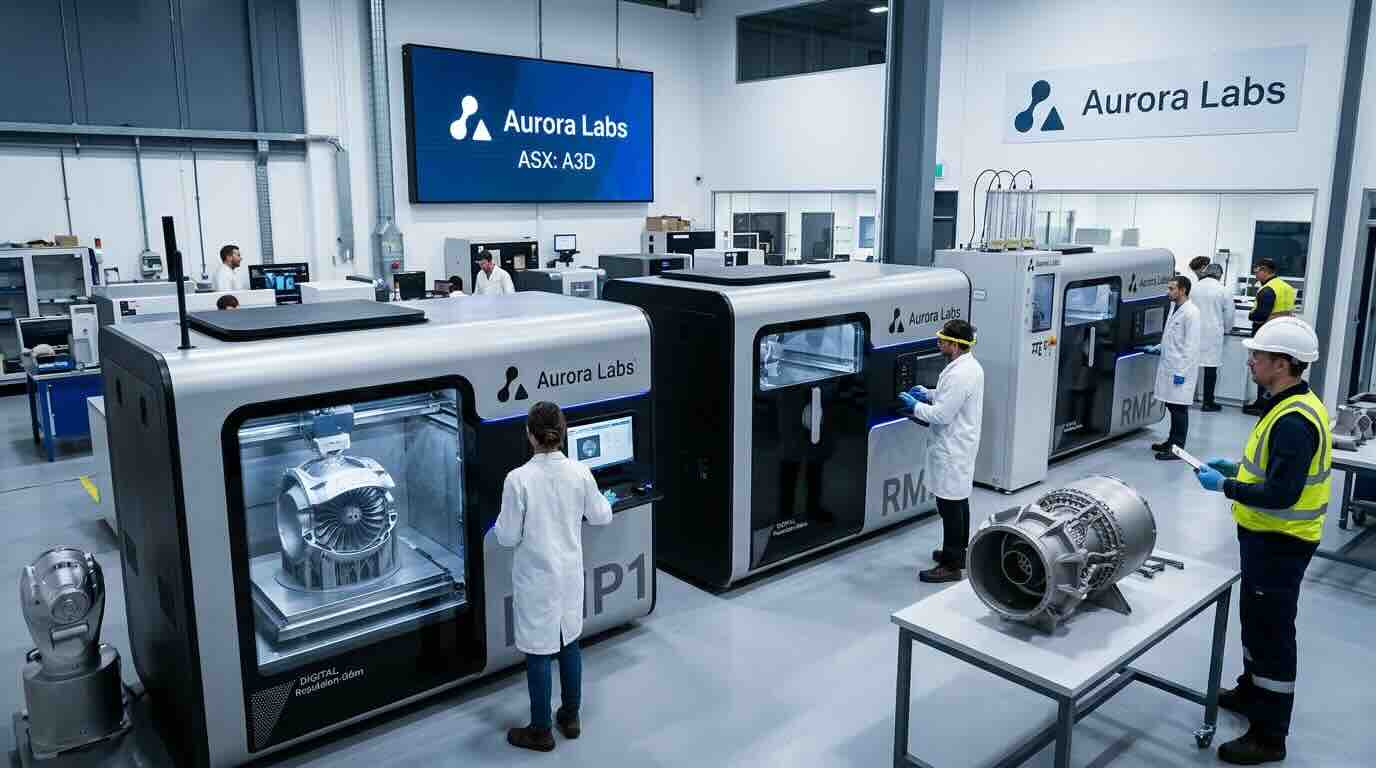
Aurora has secured commitments for a $6 million placement to accelerate production of its proprietary turbojet propulsion systems and advanced metal components.
The first tranche will raise $4.565 million, with settlement expected on 2 November. A further $1.435 million requires shareholder approval, anticipated at a general meeting in January 2027.
Significantly, engineering and manufacturing group Walkinshaw Group Holdings is participating as a strategic shareholder.
The relationship creates potential opportunities for manufacturing collaboration, although no binding production agreement has been announced.
Proceeds will support additional metal additive manufacturing equipment, production infrastructure, workforce expansion and systems required for higher-volume manufacturing.
The commercial logic is straightforward. Aurora needs greater production capacity to service potentially larger defence and aerospace orders.
However, manufacturing capability alone does not establish customer demand or profitability.
What stands out to us
Aurora's technology has progressed beyond laboratory development, but its financial performance illustrates the challenges of early-stage commercialisation.
FY26 revenue declined from $743,831 to $564,218, while the statutory loss increased 36% to $5.11 million.
Operating cash outflows reached $2.99 million, with another $1.15 million spent on property, plant and equipment.
That represents approximately $4.14 million in combined annual operating and capital expenditure outflows before financing.
The latest placement substantially strengthens Aurora's funding position, but also increases its share count.
At the last traded price of 5.9 cents, the company had a market capitalisation of approximately $31 million before the placement.
We think conventional earnings multiples offer limited valuation insight while the business remains loss-making. Its valuation instead depends heavily on future production volumes, margins and commercial contracts that remain difficult to forecast reliably.
What the company is doing now
Aurora recently secured its first US propulsion order, comprising three AU4 turbojet engines valued at US$42,000.
The order demonstrates international customer interest, although its modest value highlights the gap between initial sales and meaningful recurring revenue.
The company has also delivered AU4 engines to Sovereign Propulsion Systems, achieved AS9100D aerospace quality certification and secured a $1 million defence manufacturing grant.
Its three-year teaming agreement with global defence group MBDA provides another pathway towards future commercial opportunities.
Collectively, these developments strengthen Aurora's competitive positioning, but none guarantees large-scale procurement.
Insight: Will $6 Million Be Enough to Deliver Commercial Scale?
We think Aurora's strongest opportunity lies in combining proprietary propulsion technology with specialised Australian manufacturing capabilities. Aerospace certification, initial customer deliveries and strategic industry relationships provide encouraging evidence of commercial progress.
However, the company's financial position remains dependent on external funding while revenue is relatively small and operating expenditure continues. The placement reduces near-term financing pressure but introduces dilution without guaranteeing profitability.
Our assessment would become more favourable if Aurora secured repeat production orders, demonstrated attractive manufacturing margins and materially reduced its operating cash deficit.
What happens next?
The immediate milestones are completion of the first placement tranche, shareholder approval for the second and deployment of funds into manufacturing expansion.
Beyond financing, the critical test will be whether customer trials and strategic discussions convert into larger, repeatable orders.
The next quarterly cash flow reports should reveal whether commercial receipts are increasing relative to operating expenditure.
Aurora has made credible technological progress and secured funding to pursue its ambitions.
The challenge now is proving that a growing defence manufacturing footprint can support a commercially sustainable business rather than another cycle of capital raisings.


 Mark Elzayed•





