Impact Minerals (ASX: IPT) has announced a major strategic overhaul, placing its Lake Hope High Purity Alumina Project in Western Australia at the centre of its development plans while separating its precious and base metals exploration portfolio.
The 26 October 2026 announcement follows a management review designed to sharpen capital allocation and accelerate commercialisation. With Lake Hope carrying a preliminary valuation exceeding $1 billion, can Impact turn promising project economics into a commercially viable processing operation?
Key numbers
- $1.165 billion: Lake Hope's modelled net present value at a 10% discount rate.
- 47%: Estimated post-tax internal rate of return under the June 2025 pre-feasibility study.
- 33 years: Approximate feedstock availability supporting the proposed operation.
- $2.09 million: Cash reserves at 30 June 2026, before subsequent equity funding.
- $4.89 million: FY2026 net loss, compared with $9.02 million in FY2025.
A strategic reset puts Lake Hope first
Impact's latest announcement marks a significant change in how the company intends to allocate management attention and development capital.
Following a strategic review initiated in August, the company will prioritise its 80%-owned Lake Hope Project while managing its metals portfolio separately.
Lake Hope aims to produce high-purity alumina, a specialised material used in semiconductors, batteries, LED lighting and advanced ceramics.
The project employs a patented, low-temperature processing method designed to extract alumina from Western Australian salt lake feedstock.
Its June 2025 pre-feasibility study estimated an after-tax internal rate of return of 47%, supported by approximately 33 years of available feedstock.
These figures suggest substantial potential value, although they remain dependent on successful process validation, financing and commercial execution.
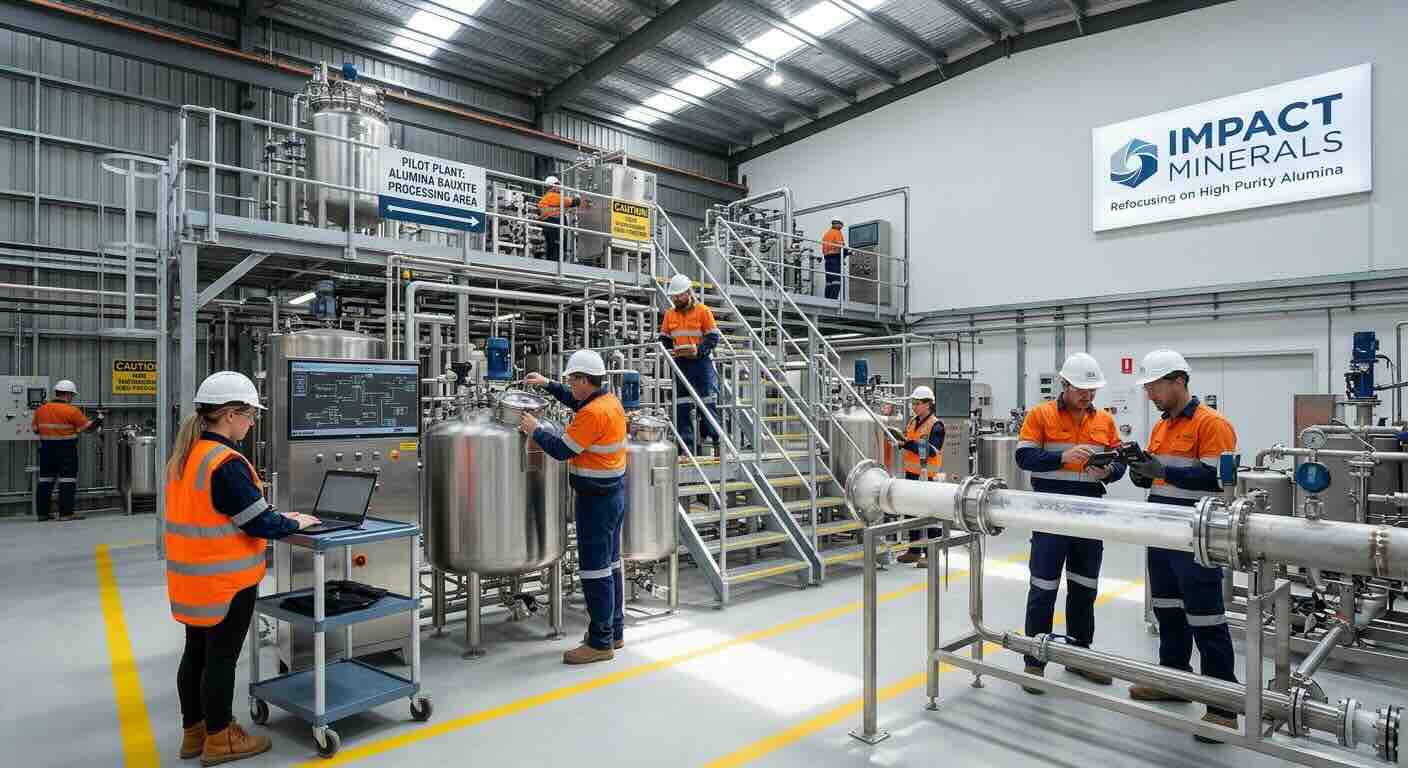
The immediate priority is completing the Lake Hope pilot plant, with commissioning targeted for 30 November 2026.
Pilot-scale processing could determine commercial viability
The shift towards Lake Hope concentrates Impact's development risk around one crucial technical milestone.
Pilot plant design has been completed, equipment purchased and installation commenced.
The programme follows extensive metallurgical testing at Edith Cowan University, where the company has been evaluating its proprietary processing flowsheet.
Successful commissioning would provide more meaningful evidence about process efficiency, product quality and operating reliability.
These factors are essential because laboratory results cannot establish commercial production economics.
The company must demonstrate that its proposed processing technology can operate consistently while producing alumina meeting demanding customer specifications.
Reliable pilot-scale performance would also support engineering work towards a definitive feasibility study.
However, processing difficulties or higher-than-expected operating costs could materially weaken the development case.
Alluminous offers a separate commercial pathway
Impact's 50%-owned associate Alluminous provides additional exposure to the high-purity alumina industry.
Unlike Lake Hope, Alluminous uses a chemical feedstock and a different processing technology.
Its Perth pilot plant has produced initial HiPurA samples for qualification by American battery technology company Charge CCCV.
A September 2026 Scoping Study examined staged production capacity ranging from 2,000 to 4,000 tonnes annually at a preferred United States location.
However, the assessment carries an estimated accuracy range of approximately plus or minus 50%, reflecting its preliminary nature.
Customer qualification also does not constitute a binding offtake agreement.
Impact intends to manage Alluminous as a separate strategic holding rather than competing with Lake Hope for operational resources.
Cash burn makes capital discipline essential
Impact's FY2026 financial results reveal improving accounting losses but continuing funding pressure.
Its annual net loss narrowed from $9.02 million to $4.89 million, primarily reflecting lower exploration impairment charges.
However, operating cash outflows increased from $1.38 million to $2.04 million.
Investing activities consumed another $3.99 million, highlighting the substantial expenditure required to advance its development portfolio.
Cash reserves stood at $2.09 million on 30 June 2026, while the company subsequently completed a rights issue raising more than $2.2 million.
Although additional funding strengthens liquidity, Impact has acknowledged that further capital will be required to sustain planned activities.
Traditional earnings multiples remain unsuitable for valuation.
Lake Hope's preliminary project economics provide a more relevant framework, but its modelled valuation should be discounted for technical, financing and development risks.
Insight: Capital allocation could become Impact's competitive advantage
What stands out to us is Impact's decision to concentrate development capital on Lake Hope while preserving exposure to partner-funded exploration. The $1.165 billion preliminary project valuation demonstrates substantial potential, but the company's limited cash reserves make disciplined expenditure essential. Separating Alluminous and the metals portfolio could improve transparency while reducing competing funding demands. We believe the strongest opportunity lies in validating Lake Hope's processing economics before pursuing major construction funding. The decisive next measure will be successful pilot plant commissioning by 30 November 2026.

 Mark Elzayed•






