American Rare Earths (ASX: ARR) is advancing plans for a major United States rare earths operation, with an expanded Cowboy State Mine development in Wyoming offering substantial long-term production potential.
The company's 29 October 2026 quarterly update highlights progress in feasibility-stage drilling, pilot-scale processing and its strategy to establish a domestic rare earth supply chain.
However, with initial development costs estimated at US$900 million and project economics dependent on higher rare earth prices, the question is whether American Rare Earths can convert its substantial mineral resources into a commercially viable mining operation.
Key numbers
- US$1.07 billion: Estimated after-tax net present value at an 8% discount rate under the September 2026 Scoping Study.
- 4.5 million tonnes: Planned annual processing capacity, representing a 50% increase over the previous development case.
- 26 years: Modelled mine life, compared with 20 years under the earlier proposal.
- US$900 million: Estimated initial development capital expenditure, including contingency.
- 21%: Projected after-tax internal rate of return, down from 24% in the previous Scoping Study.
Expanded Cowboy State Mine increases production potential
American Rare Earths' September 2026 Scoping Study represents an important development for its flagship Halleck Creek Rare Earths Project in Wyoming.
The revised Cowboy State Mine proposal increases planned processing capacity from three million to 4.5 million tonnes annually.
Its modelled operating life extends from 20 to 26 years, while average annual neodymium-praseodymium oxide production increases from approximately 1,833 tonnes to 2,500 tonnes.
These materials are essential components of permanent magnets used in electric vehicles, wind turbines, industrial equipment and defence applications.
The larger production profile could strengthen the project's strategic importance within the United States' developing domestic rare earth supply chain.
However, greater production capacity introduces additional financial exposure.
The revised study estimates initial capital expenditure of US$900 million, compared with US$456 million under the previous development case.
This substantial increase means external financing will be essential before construction can proceed.
Project valuation improves but financial returns face pressure
The updated Scoping Study estimates an after-tax net present value of approximately US$1.07 billion using an 8% discount rate.
At a more conservative 10% discount rate, the valuation declines to US$764 million.
These figures suggest substantial development potential, but the revised economics reveal important trade-offs.
The modelled after-tax internal rate of return has declined from 24% to 21%, while the reported payback period from initial capital has increased from 2.7 years to 6.9 years.
Importantly, the updated study assumes a neodymium-praseodymium oxide selling price of US$151 per kilogram, compared with US$91/kg in the previous development case.
Average operating costs are estimated at US$39.68 per tonne of material processed.
These assumptions highlight the project's sensitivity to commodity prices, processing recoveries and construction expenditure.
The US$1.07 billion valuation is a preliminary project estimate rather than an established market value.
Further feasibility studies must demonstrate whether the proposed recovery rates, production costs and development assumptions can be achieved commercially.
Drilling confirms extensive rare earth mineralisation
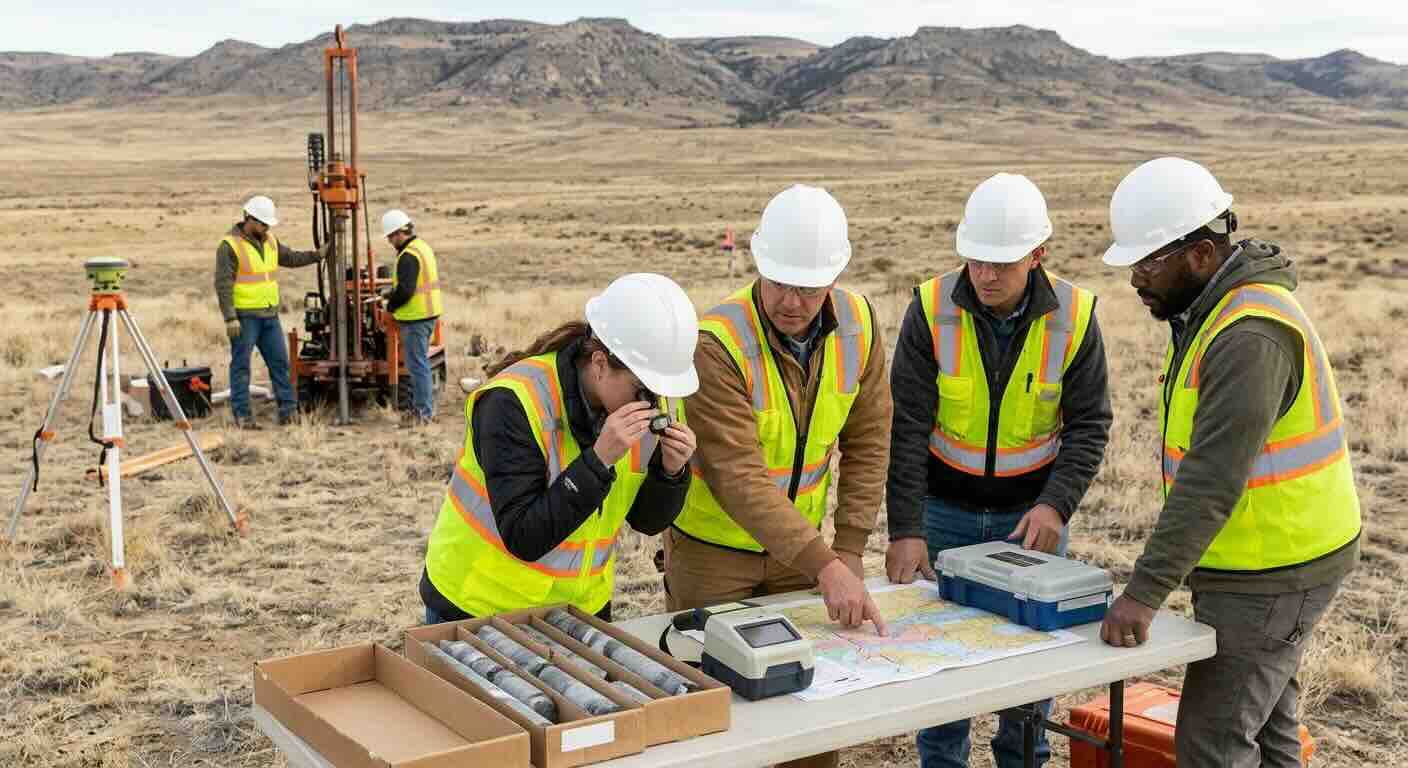
American Rare Earths completed an 18-hole feasibility-stage drilling programme during the September quarter.
Certified results from the first six holes confirmed broad, near-surface rare earth mineralisation.
Approximately 93% of the reported intervals exceeded the project's 1,000 parts per million total rare earth oxide resource cut-off grade.
The results included a continuous mineralised interval of approximately 191 metres in hole HC26-RM056.
The highest individual assay returned 9,084 parts per million total rare earth oxides over 3.02 metres.
These findings support further evaluation of mine planning and geological continuity.
Halleck Creek hosts a reported JORC Mineral Resource of approximately 2.63 billion tonnes grading 3,292 parts per million total rare earth oxides.
The resource contains approximately 8.65 million tonnes of rare earth oxides.
However, Mineral Resources are not equivalent to economically recoverable Ore Reserves.
The updated Scoping Study's production target is based on Indicated Mineral Resources, but no Ore Reserves have been declared.
Further drilling, engineering and economic studies are required before commercial viability can be established.
Pilot processing becomes the next major technical milestone
American Rare Earths has commenced crushing Halleck Creek ore as part of its Wyoming-led pilot plant programme.
The programme is designed to assess mineral concentration, leaching, impurity removal and rare earth oxide separation.
Testing is being undertaken through collaborations involving Western Research Institute, DISA Technologies and Saskatchewan Research Council.
The company is also conducting additional recovery optimisation work to improve processing efficiency.
This is particularly important because extracting valuable rare earth materials economically from a large, relatively low-grade resource requires efficient processing.
The updated development case incorporates different recovery assumptions from the earlier study, making pilot-scale validation essential.
American Rare Earths is targeting production of separated rare earth oxides from its pilot and demonstration programme in late Q2 2027.
Successful results could reduce technical uncertainty and support more detailed feasibility work.
However, pilot performance does not guarantee commercial-scale recovery rates, manufacturing reliability or acceptable operating costs.
Novex partnership supports a domestic mine-to-magnet strategy
American Rare Earths is expanding its ambitions beyond mining and oxide production.
In August 2026, the company signed a Memorandum of Understanding with US-based Novex to investigate converting neodymium-praseodymium oxide into high-purity rare earth metal.
This represents an important potential step towards establishing a more complete domestic rare earth supply chain.
Permanent magnet manufacturing requires processed rare earth metals and alloys rather than simply mined concentrates.
The collaboration could help connect Halleck Creek's proposed oxide production with downstream manufacturers serving industrial, energy and defence markets.
A 40-kilogram concentrate sample has been provided to Novex for further processing and recovery evaluation.
However, the agreement remains preliminary and does not guarantee commercial manufacturing, customer purchases or future revenue.
The company must still establish technical feasibility, competitive costs and binding commercial arrangements.
Financial resources support studies but not full construction
American Rare Earths remains a development-stage company without established commercial mining revenue.
Its FY2026 net loss narrowed to approximately A$5.72 million from A$6.47 million in FY2025.
Annual operating cash outflows declined slightly from A$4.43 million to A$4.22 million.
However, exploration expenditure increased to approximately A$13.13 million as technical development accelerated.
Cash reserves reached A$18.55 million at 30 June 2026, supported by equity funding and option exercises.
Although this provides financial flexibility for ongoing studies, the balance represents only a small fraction of the proposed US$900 million construction requirement.
The company previously received a non-binding financing indication of up to US$456 million from the Export-Import Bank of the United States.
However, this should not be interpreted as committed development funding.
The September-quarter financial position requires continued monitoring as feasibility studies and pilot processing progress.
With no established operating earnings, conventional earnings multiples remain unsuitable.
Risk-adjusted project economics, capital requirements, dilution potential and future financing conditions offer more meaningful valuation considerations.
Insight: Processing economics matter more than resource size
What stands out to us is the contrast between Halleck Creek's substantial rare earth resource and the rising capital requirements of its proposed development.
The revised US$1.07 billion after-tax project valuation suggests meaningful potential, but initial capital has increased to US$900 million, while the modelled internal rate of return has declined to 21%.
We believe American Rare Earths could benefit from growing demand for domestic US magnet materials, particularly if its processing technology demonstrates competitive recovery rates and operating costs.
However, the US$151/kg neodymium-praseodymium price assumption and substantial financing requirement introduce considerable uncertainty.
The market may be overlooking the importance of recovery optimisation, especially because improved processing efficiency could materially affect the project's eventual economics.
Our assessment would strengthen if pilot testing validated the proposed recovery assumptions, feasibility studies established credible construction costs and management secured binding financing arrangements without excessive shareholder dilution.


 Mark Elzayed•





