Mithril Silver and Gold Limited (ASX: MTH) has reported a further extension of high-grade silver-gold mineralisation at its Copalquin Project in Mexico, with its latest announcement identifying mineralisation extending to 700 metres at Target 4.
The 30 October 2026 development follows the company's September quarterly report, which confirmed high-grade drilling results across a 550-metre strike and the commencement of economic studies at its established Target 1 resource.
The expanding mineralised footprint strengthens the potential for a second resource area within the Copalquin district.
However, with cash reserves declining as exploration accelerates, the central question is whether Mithril can convert its discoveries into commercially viable mineral resources before further financing becomes necessary.
Key numbers
- 700 metres: High-grade mineralisation extent highlighted in Mithril's 30 October 2026 Target 4 announcement.
- 13.95m at 387g/t silver equivalent: Previously reported Target 4 drilling intersection, including 1m at 1,747g/t.
- 615,000 ounces: Target 1 Mineral Resource expressed as contained gold equivalent.
- 25,000 metres: Planned 2026 drilling programme, approaching completion at the end of October.
- $4.13 million: Cash reserves at 30 September 2026, down from approximately $7.26 million in June.
Target 4 expands to 700 metres of high-grade mineralisation
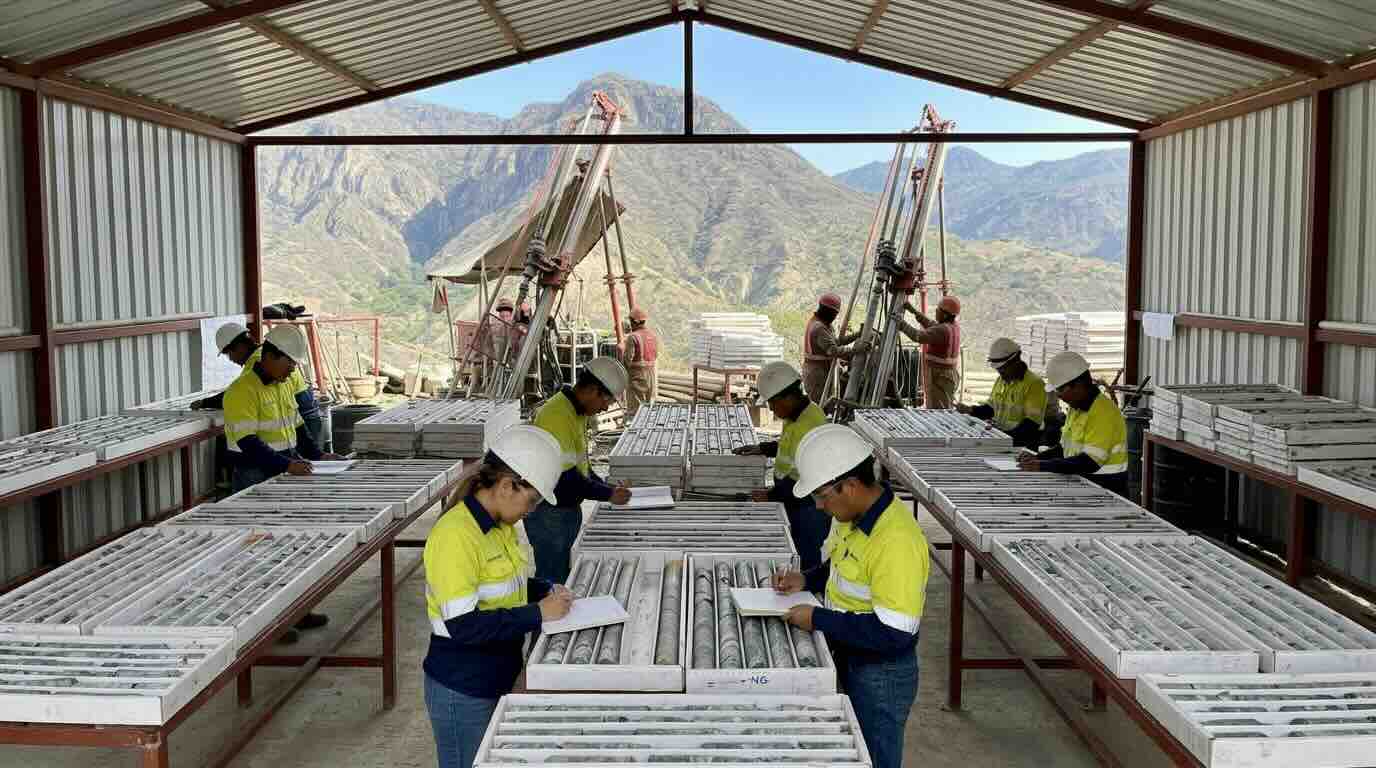
The latest exploration development at Mithril's Copalquin Project is the extension of high-grade silver-gold mineralisation at Target 4.
On 30 October, the company released an announcement titled High-Grade Mineralisation to 700m at Copalquin Target 4, indicating further progress beyond the 550-metre mineralised strike reported in August and reiterated in its September quarterly update.
The earlier drilling established silver-gold mineralisation across approximately 550 metres of strike and 200 metres vertically along the Copalquin-Zaragoza structure.
The structure forms part of a broader mineralised corridor within the company's Copalquin district in Durango, Mexico.
The previous results included 11.70 metres grading 456 grams per tonne silver equivalent from 22 metres in hole CO26-001.
Within that intersection, drilling returned 3.40 metres at 1,239g/t silver equivalent, including a narrow high-grade interval of 0.60 metres at 3,877g/t.
Another hole, CO26-002, intersected 13.95 metres grading 387g/t silver equivalent from 88.85 metres, including one metre at 1,747g/t.
These results demonstrate substantial localised silver-gold grades within the mineralised structure.
However, narrow high-grade intersections should not be assumed to represent the average grade of an eventual deposit.
The newly announced 700-metre extent suggests continued exploration progress, although the detailed new drilling results and geological dimensions require assessment before the additional mineralisation can be fully quantified.
Copalquin-Zaragoza offers potential for a second resource area
Target 4 is emerging as an important component of Mithril's broader Copalquin exploration strategy.
The company's geological interpretation suggests the Copalquin-Zaragoza structure could extend across approximately 1.5 kilometres.
Earlier drilling demonstrated that mineralisation remains open along the structure, including areas towards the established Target 1 resource and the historic San Manuel mine.
Mithril has been applying geological interpretations developed at El Refugio to better understand how mineralisation continues around post-mineral intrusive structures.
This approach has helped identify additional prospective areas along the corridor.
The extension of high-grade mineralisation provides encouragement that Target 4 could eventually support a separate Mineral Resource estimate.
However, a mineralised strike length does not establish the volume, grade continuity or economic recoverability of a deposit.
Further drilling must demonstrate the consistency of mineralisation along strike and at depth.
Resource modelling, metallurgical evaluation and mine planning would also be required before the potential commercial value of Target 4 can be assessed.
For investors, the distinction between exploration success and resource definition remains important.
Target 1 moves towards an economic assessment
Alongside Target 4 exploration, Mithril has commenced a Scoping Study and Preliminary Economic Assessment for Target 1.
This follows the upgraded June 2026 Mineral Resource Estimate covering the El Refugio and La Soledad deposits.
The resource totals approximately 4.83 million tonnes containing 446,000 ounces of gold and 11.88 million ounces of silver.
Expressed as gold equivalent, the inventory contains approximately 615,000 ounces.
Approximately 75% of the contained metal is classified as Indicated, providing greater geological confidence than Inferred resources.
The updated estimate also incorporates preliminary underground mining shapes and expected mining dilution.
These refinements provide a stronger technical foundation for assessing potential underground development.
However, Mineral Resources are not equivalent to economically recoverable Ore Reserves.
The Preliminary Economic Assessment, targeted for early 2027, will investigate potential production rates, mining methods, capital requirements, operating costs and project economics.
Its findings could materially influence Mithril's development strategy.
Until those studies are completed, the company's project value remains dependent on assumptions about mineral recovery, operating costs and future gold and silver prices.
Further drilling strengthens the established resource area
Mithril's September quarterly report also included additional drilling results around its existing Target 1 deposits.
At La Soledad, hole LS26-008 intersected 13.45 metres grading 1.55 grams per tonne gold and 16.6 grams per tonne silver from 30.4 metres.
This included 0.50 metres grading 27.90g/t gold and 156g/t silver.
At El Refugio, drilling returned 0.55 metres grading 7.54g/t gold and 17.4g/t silver from 404.95 metres.
These results provide further evidence of mineralisation around the established resource areas.
However, the intersections do not automatically increase the existing Mineral Resource.
Additional drilling and geological modelling would be required to determine whether the results justify future resource revisions.
For Mithril, continued resource-definition work could potentially improve the scale or confidence of the mineral inventory available for future mine planning.
District-wide exploration provides additional opportunities
Beyond Targets 1 and 4, Mithril continues investigating several prospective areas across its Mexican project portfolio.
At La Maquina, Target 5, follow-up drilling intersected 0.50 metres grading 12.20g/t gold and 848g/t silver.
The result extended the high-grade discovery approximately 150 metres northwest.
Mithril has also identified future drilling opportunities at La Dura, Targets 3 and 5, and Cucaracha.
The company has been advancing its fully funded 25,000-metre drilling programme for 2026, with completion scheduled around the end of October.
Additional exploration is planned for 2027.
These activities provide opportunities to identify further mineralised structures across the district.
However, pursuing multiple targets simultaneously increases the importance of disciplined capital allocation.
The company must balance ongoing discoveries with the need to advance economic studies and establish a credible pathway towards future production.
Declining cash reserves highlight the funding challenge
Mithril's September-quarter financial position demonstrates the cost of advancing an exploration-intensive portfolio.
Cash reserves declined from approximately $7.26 million at 30 June to $4.13 million at 30 September 2026.
During the quarter, operating cash outflows totalled approximately $544,000.
Exploration and evaluation expenditure consumed a further $2.58 million.
Combined relevant expenditure therefore reached approximately $3.12 million.
The company also received approximately $270,000 in Mexican value-added tax refunds during the quarter.
Mithril remains debt-free, providing some financial flexibility.
However, its Appendix 5B disclosed an estimated 1.32 quarters of available funding based on recent expenditure.
Management indicated that the current expenditure rate was not expected to continue unchanged as the 2026 drilling programme approached completion.
Nevertheless, the company also acknowledged that future debt or equity financing may be required to support planned activities.
Additional equity funding could dilute existing shareholders, while debt financing may introduce repayment obligations before the project generates commercial revenue.
Mithril's FY2026 statutory net loss also widened to approximately $5.27 million from $2.12 million in FY2025.
With no established mining revenue, conventional earnings multiples remain unsuitable for valuation.
Resource quality, development economics, funding requirements and potential future operating cash flows provide more meaningful investment considerations.
Insight: Resource conversion matters more than increasingly high-grade discoveries
What stands out to us is Mithril's opportunity to combine an established 615,000-ounce gold-equivalent resource at Target 1 with an expanding mineralised structure at Target 4.
The latest announcement identifying high-grade mineralisation over 700 metres strengthens the exploration case for a second potential resource area.
However, geological scale and high-grade drill intercepts do not automatically establish commercially recoverable mineral inventories.
We believe the market should focus on whether Target 4 can support a credible Mineral Resource and whether the Target 1 Preliminary Economic Assessment demonstrates attractive underground mining economics.
Mithril's declining cash reserves also increase the importance of disciplined exploration expenditure and future funding arrangements.
Our assessment would strengthen if the company delivered further evidence of continuous mineralisation, economically attractive development costs and a credible financing strategy.
The decisive next measures will be Target 4 resource-definition results and the Target 1 economic assessment expected in early 2027.

 Mark Elzayed•






