Reece (ASX: REH) has opened FY2027 with stronger sales momentum, reporting group revenue of $2.51 billion during the September quarter as its Australia and New Zealand operations delivered double-digit growth.
The company's 30 October 2026 trading update revealed a 12.8% increase in ANZ sales, contrasting with more subdued underlying demand across its United States distribution network.
However, the improved sales performance follows a financial year in which revenue increased but profitability declined as operating expenditure outpaced growth.
With its international branch network continuing to expand, the central question is whether Reece can convert stronger customer demand into sustainable earnings growth and improved operating margins.
Key numbers
- $2.51 billion: Q1 FY2027 group sales, up 4.3% year-on-year and 8.7% on a constant-currency basis.
- 12.8%: Australia and New Zealand sales growth during the September quarter.
- 5.6%: US sales growth, with like-for-like sales increasing 2.4%.
- $9.38 billion: FY2026 group revenue, up 4.5% year-on-year.
- $901 million: FY2026 EBITDA, broadly unchanged despite higher annual revenue.
Australia and New Zealand drive quarterly sales growth
Reece's latest trading update highlighted strong sales momentum across its Australia and New Zealand operations.
Regional sales increased 12.8% during the first quarter of FY2027, supported by continued improvement in volumes and a mid-single-digit contribution from inflation.
The result represents an acceleration from the 8.3% regional revenue growth recorded during FY2026.
This suggests underlying customer demand has strengthened across Reece's established distribution network.
However, some of the reported increase reflects higher selling prices rather than additional product volumes.
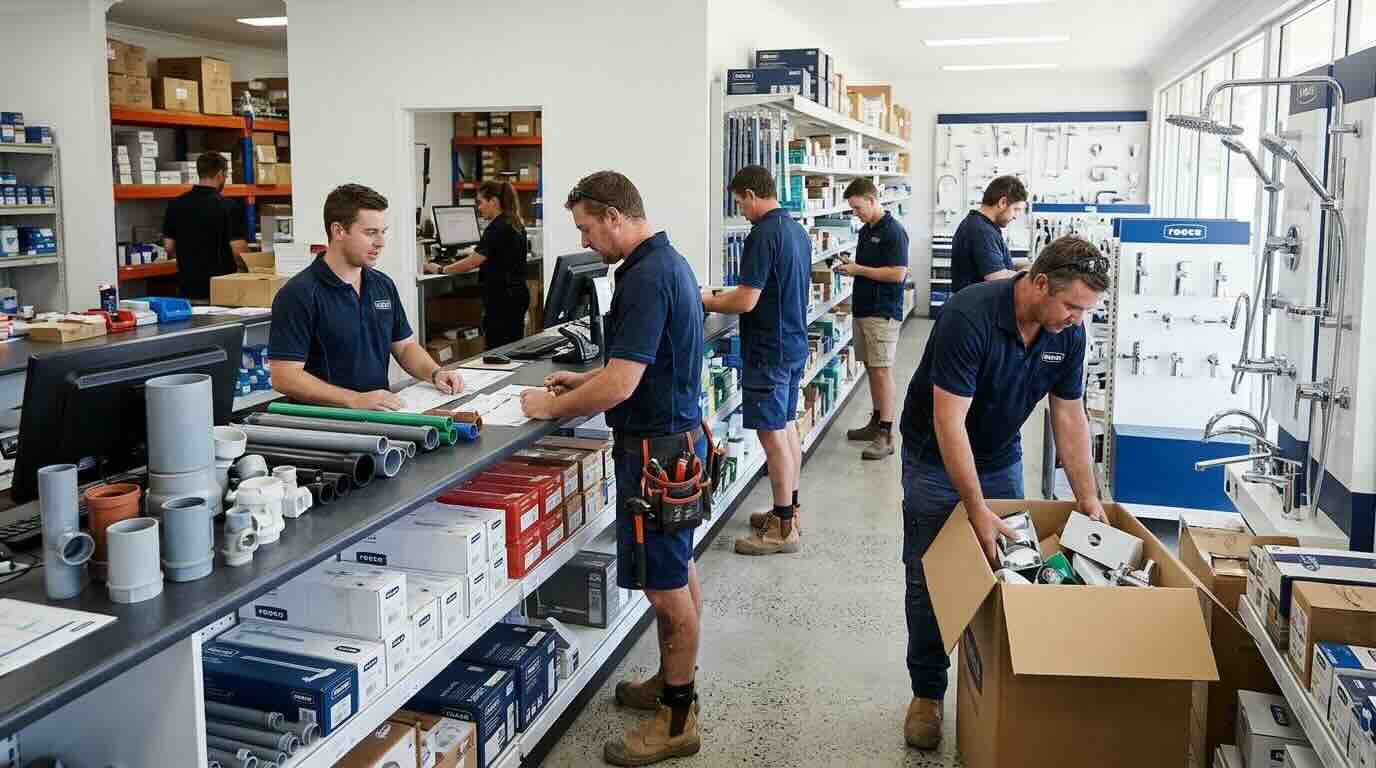
Reece distributes plumbing supplies, bathroom products, waterworks materials and heating, ventilation and air-conditioning equipment to trade customers.
Its extensive branch network provides a competitive advantage through product availability, established customer relationships and convenient distribution.
The company has continued investing in digital capabilities, customer experience and branch productivity.
During FY2026, Reece opened a next-generation bathroom showroom in Sydney, introducing digital tools designed to improve product selection and customer engagement.
These initiatives could strengthen customer retention and support higher sales productivity.
Management expects Australia and New Zealand to deliver a strong first half of FY2027, although it remains cautious about the second half because of broader economic uncertainty.
US sales improve but housing weakness remains
Reece's United States operations remain central to its longer-term growth strategy.
US sales increased 5.6% during the September quarter, supported by network expansion and low-single-digit inflation.
However, like-for-like sales growth reached only 2.4%.
The distinction is important because total revenue growth includes the contribution from newly opened branches, while comparable sales provide a clearer indication of performance across established locations.
Even so, like-for-like sales growth is not equivalent to volume growth because it may include pricing effects.
The US residential new construction market remains subdued, limiting opportunities for a stronger recovery in underlying demand.
During FY2026, Reece's US revenue increased 6.5% in local currency to approximately US$3.5 billion.
The company opened a net 25 additional US branches during the financial year, expanding its geographic presence and customer reach.
However, new branches require additional staffing, inventory, property and operating expenditure before reaching mature profitability.
This creates a challenge when underlying housing demand remains weak.
For Reece, the next meaningful test will be whether existing US branches can improve comparable sales and operating efficiency without requiring proportionate increases in costs.
Currency movements affect reported group performance
Reece reported group sales revenue of approximately $2.51 billion for the September quarter, representing a 4.3% increase over the previous corresponding period.
However, on a constant-currency basis, sales increased 8.7%.
This difference demonstrates the effect of foreign exchange movements on the company's reported Australian-dollar revenue.
Because the US business contributes a substantial proportion of group sales, changes in the Australian dollar against the US dollar can materially affect consolidated results.
A stronger Australian dollar can reduce the reported value of US revenue when translated into Australian currency, even if local trading performance improves.
Consequently, investors should assess both reported and constant-currency growth when evaluating Reece's underlying operating momentum.
The latest figures suggest stronger business activity than the headline 4.3% reported growth rate alone might indicate.
However, currency-adjusted sales growth does not establish that operating margins or profitability improved during the quarter.
The trading update did not provide quarterly EBITDA, EBIT or net profit figures.
FY2026 revenue growth fails to lift operating earnings
Reece's FY2026 financial results demonstrate why stronger sales alone will not complete its earnings recovery.
Group revenue increased 4.5% to approximately $9.38 billion, compared with $8.98 billion in FY2025.
However, EBITDA remained broadly unchanged at $901 million.
The implied EBITDA margin declined from approximately 10.0% to 9.6%.
Operating costs excluding depreciation and amortisation increased 9.6% to approximately $1.82 billion.
The increase reflected continued investment in branch expansion, digital transformation, technology capabilities and employee remuneration initiatives.
EBIT subsequently declined 2.6% to $534 million, compared with $548 million previously.
Net profit fell 2.8% to $308 million from $317 million.
These results suggest that rising operating expenditure absorbed much of the benefit from stronger revenue.
Nevertheless, Reece remains substantially profitable, supported by established distribution operations across two major geographic markets.
The company's challenge is improving productivity and cost efficiency while continuing to invest in future growth.
For valuation purposes, sustainable EBIT margins, return on capital and operating cash generation remain particularly important.
Stronger cash flow contrasts with higher net debt
Despite weaker accounting profitability, Reece generated stronger operating cash flow during FY2026.
Net operating cash inflows increased to approximately $645 million, compared with $600 million in FY2025.
Capital expenditure declined from $258 million to $174 million.
This improved cash generation after capital expenditure, providing additional financial flexibility.
However, net debt increased from approximately $590 million to $744 million.
The increase reflected continued investment in the business and partial funding of the company's share buyback programmes.
Reece reported a net leverage ratio of approximately 1.0 times at 30 June 2026.
This suggests borrowing remained manageable relative to its earnings base, although leverage increased compared with the previous financial year.
The company also reported an increase in net working capital of approximately $35 million, reflecting additional inventory to support branch expansion and product availability.
Maintaining sufficient inventory is important to Reece's customer service proposition, but it also ties up capital.
Further debt accumulation could become more challenging if earnings remain under pressure or US construction conditions deteriorate.
Investors should therefore monitor operating cash flow, working capital requirements, capital expenditure and debt alongside revenue growth.
Branch productivity becomes central to margin recovery
Reece's distribution model depends on providing trade customers with convenient access to products through an extensive branch network.
Continued expansion creates opportunities to capture additional market share and strengthen customer relationships.
However, branch growth also introduces fixed operating costs.
New locations require staffing, inventory, property expenditure and investment in supporting technology.
If sales volumes remain subdued, these expenses can weigh on profitability before the branches reach mature performance levels.
The company's FY2026 results illustrate this challenge.
Revenue increased, but EBITDA remained unchanged as operating costs grew faster than sales.
Improving productivity across existing branches could therefore provide a more immediate earnings opportunity than relying exclusively on further network expansion.
Higher sales per branch, better inventory management and stronger workforce efficiency could support operating leverage without equivalent increases in capital expenditure.
However, Reece must balance efficiency initiatives with maintaining product availability and service quality.
The next earnings results will be important in determining whether stronger ANZ sales and improving US comparable sales are translating into better financial performance.
Insight: Existing branch productivity matters more than network expansion
What stands out to us is the growing contrast between Reece's Australian operations and its US business.
Australia and New Zealand delivered 12.8% sales growth during the September quarter, supported by stronger volumes and some inflation-related pricing benefits.
Meanwhile, US sales increased 5.6%, but like-for-like growth reached only 2.4%, suggesting branch expansion remains an important contributor to revenue growth.
We believe Reece's established distribution network provides opportunities for stronger earnings if existing branches can improve productivity without proportionate increases in operating expenditure.
However, FY2026 demonstrated that revenue growth does not necessarily produce stronger profitability, with group EBITDA remaining flat despite a 4.5% sales increase.
The market may be overlooking the importance of operating leverage, particularly across the US network where housing construction remains subdued.
Our assessment would strengthen if Reece demonstrated sustained comparable-sales growth, improving EBITDA margins and disciplined capital allocation while maintaining strong operating cash flow.
The decisive next measure will be whether the company's improving sales momentum translates into higher operating earnings.


 Mark Elzayed•





