RareX Limited (ASX: REE) is expanding its critical minerals opportunities, with a 74-metre copper sulphide zone at Khaleesi adding another potential growth driver. But while exploration progress and improving rare earth processing results strengthen its portfolio, a more immediate question remains: can the company convert its assets into commercial value before funding requirements increase?
Its latest quarterly figures reveal both financial flexibility and potential pressure.
Key numbers
- 74 metres: Copper sulphide mineralisation identified at Khaleesi's Niobe prospect, pending certified laboratory assays.
- 5,724ppm copper: Peak preliminary portable XRF reading, equivalent to approximately 0.57% copper.
- 25.15% TREO: Rare earth concentrate grade achieved through metallurgical testwork at Cummins Range, with rougher recovery reaching 74.6%.
- $2.78 million: Cash and cash equivalents at 30 September 2026.
- $5.99 million: Reported market value of share investments at quarter-end.
Latest quarterly results highlight exploration progress
RareX's 30 October quarterly report confirmed progress across its Western Australian critical minerals portfolio.
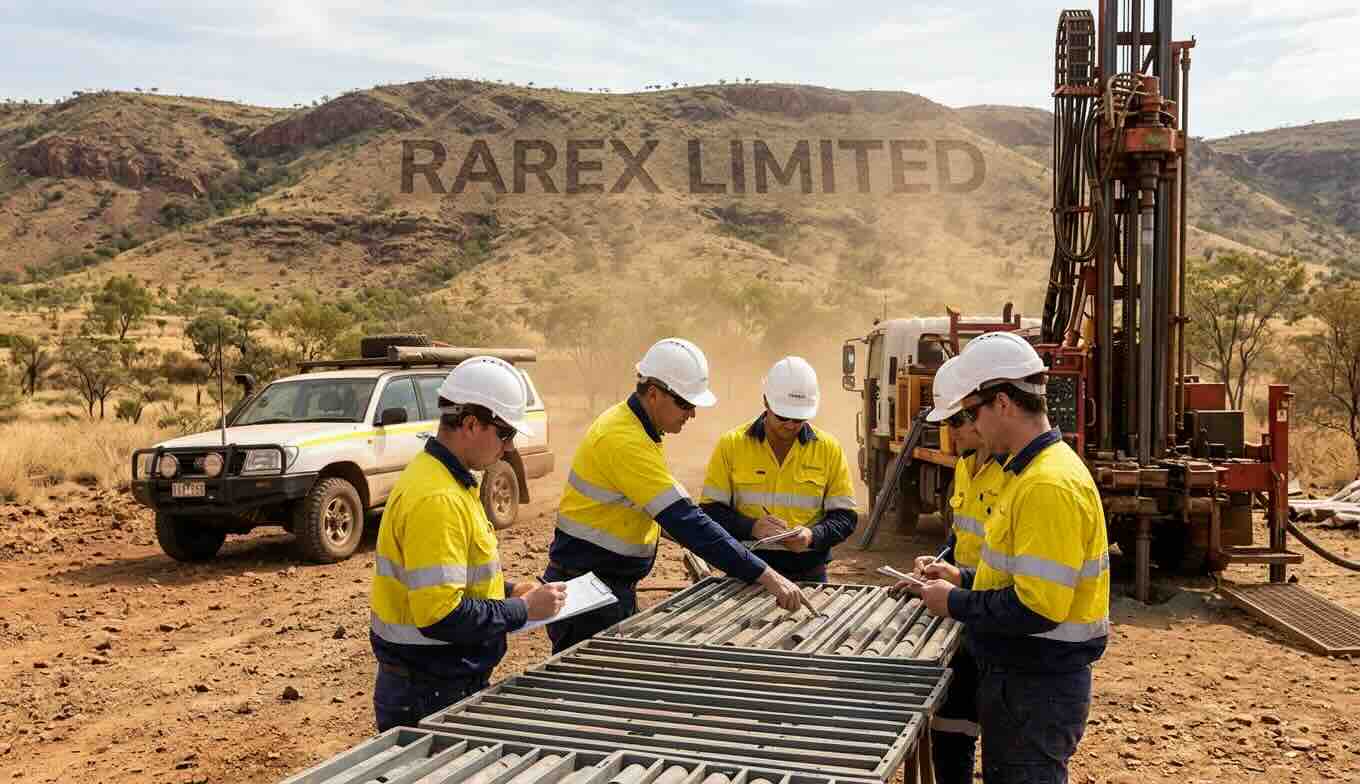
At Khaleesi, maiden reverse circulation drilling completed 1,953 metres across five target areas.
The standout result came from hole KRC012 at Niobe, where a 74-metre zone of anomalous copper sulphide mineralisation was identified from approximately 77 metres downhole.
Preliminary portable XRF readings peaked at 5,724ppm copper, with several intervals exceeding 1,500ppm.
However, these readings are not certified laboratory assays and cannot establish reliable average grades or economic value.
RareX expects laboratory results in early November, potentially providing clearer evidence of the system's mineralisation.
The company believes geological alteration could indicate proximity to a higher-grade source, although that interpretation requires further exploration.
What stands out to us
RareX's diversified portfolio offers exposure to copper, rare earths, gallium, scandium and niobium.
However, diversification also creates competing funding demands.
During the September quarter, operating cash outflow reached $1.303 million, including $447,000 spent on exploration and evaluation.
Cash declined from $4.085 million to $2.78 million, leaving an estimated 2.13 quarters of funding at the reported expenditure rate.
Importantly, RareX also held approximately $5.99 million in share investments, primarily through Kincora Copper and EAU Lithium.
These holdings provide potential liquidity beyond cash reserves, although their values fluctuate and realisation proceeds are uncertain.
We think this financial distinction matters. RareX's cash balance alone understates its available financial resources, but its listed holdings should not be treated as equivalent to unrestricted cash.
What the company is doing now
RareX continues advancing Cummins Range towards potential commercial development.
Recent metallurgical testing achieved a 9.5-fold rare earth concentration upgrade to 25.15% total rare earth oxides, with rougher recovery reaching 74.6%.
Additional work demonstrated near-complete gallium extraction under tested conditions and scandium recoveries of 89% to 93%.
With its mining lease granted and heritage arrangements progressing, RareX is assessing development pathways and potential strategic partnerships.
Meanwhile, RareX and Iluka Resources submitted a proposal for Kenya's Mrima Hill critical minerals project on 23 October.
The proposal remains subject to a competitive government process, with no certainty of an award.
Insight: Is RareX's Biggest Opportunity Beyond Khaleesi?
We think Cummins Range currently offers a more credible pathway towards commercial value than Khaleesi's early-stage copper discovery. Metallurgical improvements provide measurable technical progress, while the company's share investments offer financial flexibility. However, neither establishes a profitable mining operation. RareX still needs convincing project economics, funding arrangements and a viable development strategy. Khaleesi could strengthen the broader portfolio if certified assays confirm meaningful mineralisation, but its economic potential remains unproven. Our assessment would improve with commercially attractive processing results, stronger drilling evidence and strategic funding that limits dilution.

 Mark Elzayed•






