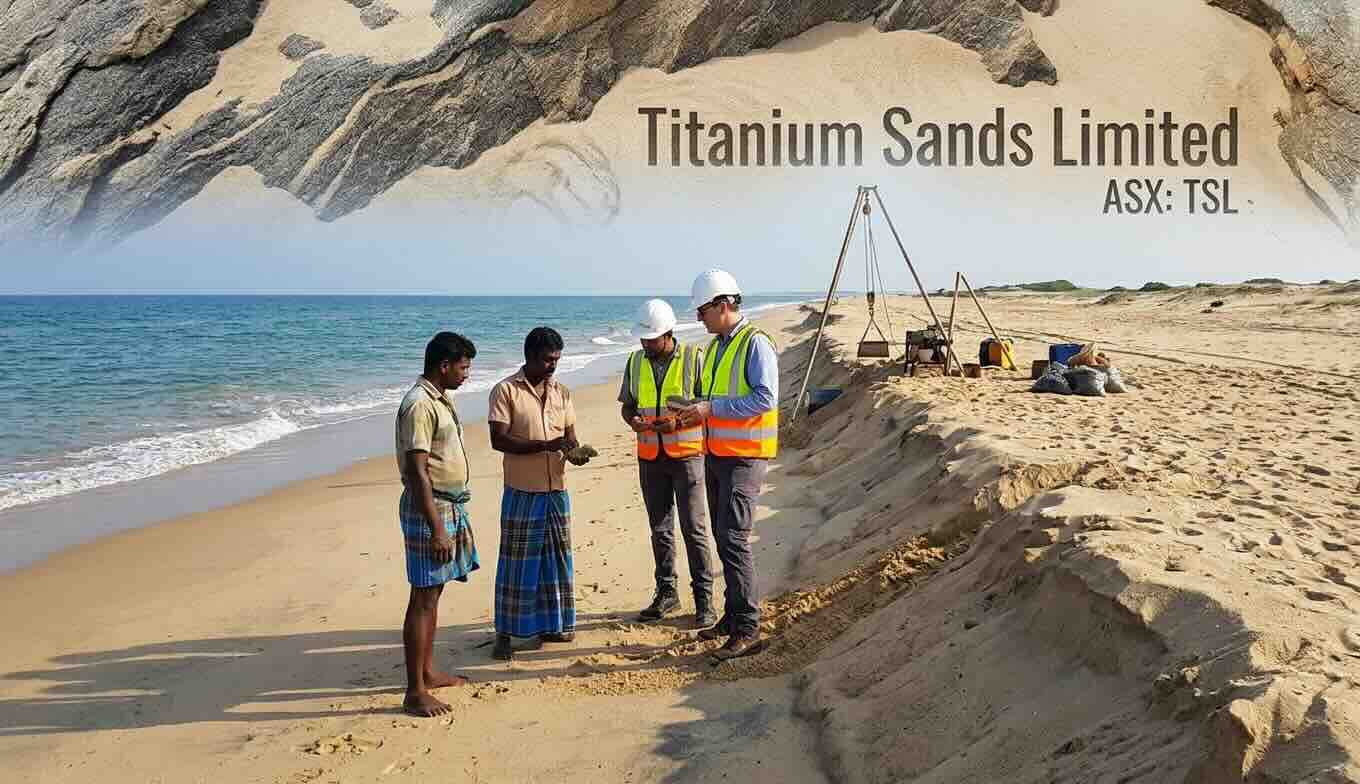
Titanium Sands Limited (ASX: TSL) has completed critical environmental fieldwork for its Mannar Heavy Mineral Project in Sri Lanka, bringing the proposed mining operation another step closer to regulatory assessment.
However, its latest quarterly report reveals a more immediate challenge: just $61,000 in cash, fully drawn loan facilities and less than one quarter of estimated funding remaining.
The central question is whether Titanium Sands can secure enough capital to advance Mannar without substantial further shareholder dilution.
Key numbers
- $61,000: Cash balance at 30 September 2026.
- $291,000: Combined operating and investing cash outflows during the September quarter.
- $1.8 million: Total reported loan facilities, fully drawn.
- 0.21 quarters: Estimated funding available at quarter-end.
- $243,000: Proceeds from equity securities issued during the quarter.
The latest development
Titanium Sands' 30 October quarterly report confirmed completion of environmental field investigations, technical assessments and data collection required for the Environmental Impact Assessment (EIA) of its Mannar project.
The work examined groundwater, biodiversity, community impacts, rehabilitation and environmental management.
The completed documentation is undergoing review ahead of submission to Sri Lanka's Central Environmental Authority.
This follows a June hydrology study that identified no significant groundwater impacts under the proposed mining methodology.
However, completing environmental studies does not constitute regulatory approval.
The project still requires environmental clearance and an Industrial Mining Licence before commercial development can proceed.
Titanium Sands also faces outstanding exploration licence renewals across its reported project tenure, adding another regulatory consideration.
What stands out to us
The most significant issue is the widening gap between project development ambitions and available funding.
During the September quarter, Titanium Sands recorded $179,000 in operating cash outflows and $112,000 in exploration and evaluation expenditure.
Despite receiving $243,000 from equity securities, the company finished September with only $61,000 in cash.
Its reported $1.8 million loan facilities were fully drawn, leaving no disclosed undrawn borrowing capacity under those arrangements.
The estimated funding runway of 0.21 quarters highlights the urgency of securing additional capital.
Mannar's mineral sands potential provides a basis for continued development interest, but the project remains exposed to regulatory, financing and execution risks.
A commercially attractive resource does not automatically translate into profitable production.
Mining costs, mineral recoveries, processing requirements, infrastructure expenditure and realised product prices will ultimately determine economic viability.
Without updated, sufficiently detailed project economics, assigning a reliable project-based equity valuation remains difficult.
What the company is doing now
Titanium Sands continues progressing environmental approvals while exploring strategic funding and product offtake opportunities.
Its non-exclusive consulting agreement with UK-based Global Mining Synergies is intended to facilitate discussions with Chinese counterparties regarding mine development, financing and mineral sands supply.
These relationships could potentially provide access to development capital and future customers.
However, the company has not disclosed a completed binding project financing agreement or contracted offtake arrangement.
Titanium Sands is also advancing updated scoping study work to better establish the project's development requirements and commercial potential.
The immediate priority remains securing sufficient working capital to maintain operations while regulatory and commercial discussions progress.
Insight: Can Mannar's Potential Overcome Titanium Sands' Funding Risk?
We think Mannar presents a credible mineral sands development opportunity, but Titanium Sands' financial position remains its greatest immediate weakness. Completing environmental fieldwork is encouraging, yet regulatory progress does not resolve the company's limited liquidity or substantial future capital requirements. Outstanding licence renewals introduce another uncertainty. A binding development funding agreement could materially strengthen the outlook and reduce dependence on repeated equity raisings. Until financing terms, regulatory approvals and updated project economics become clearer, we believe the commercial opportunity remains difficult to value confidently despite its underlying resource potential.
What happens next?
Three developments will determine whether Titanium Sands can translate technical progress into commercial value.
The first is formal EIA submission, subsequent environmental assessment and progress towards obtaining an Industrial Mining Licence.
The second is resolving outstanding exploration licence renewals and maintaining the regulatory certainty required for development.
The third, and arguably most urgent, is securing additional working capital and converting strategic financing discussions into enforceable agreements.
For existing shareholders, the terms of future funding could prove as consequential as regulatory approvals.
Mannar's potential remains compelling enough to warrant attention, but Titanium Sands must demonstrate that it can finance the transition from environmental assessment to a commercially viable mining operation.

 Mark Elzayed•






